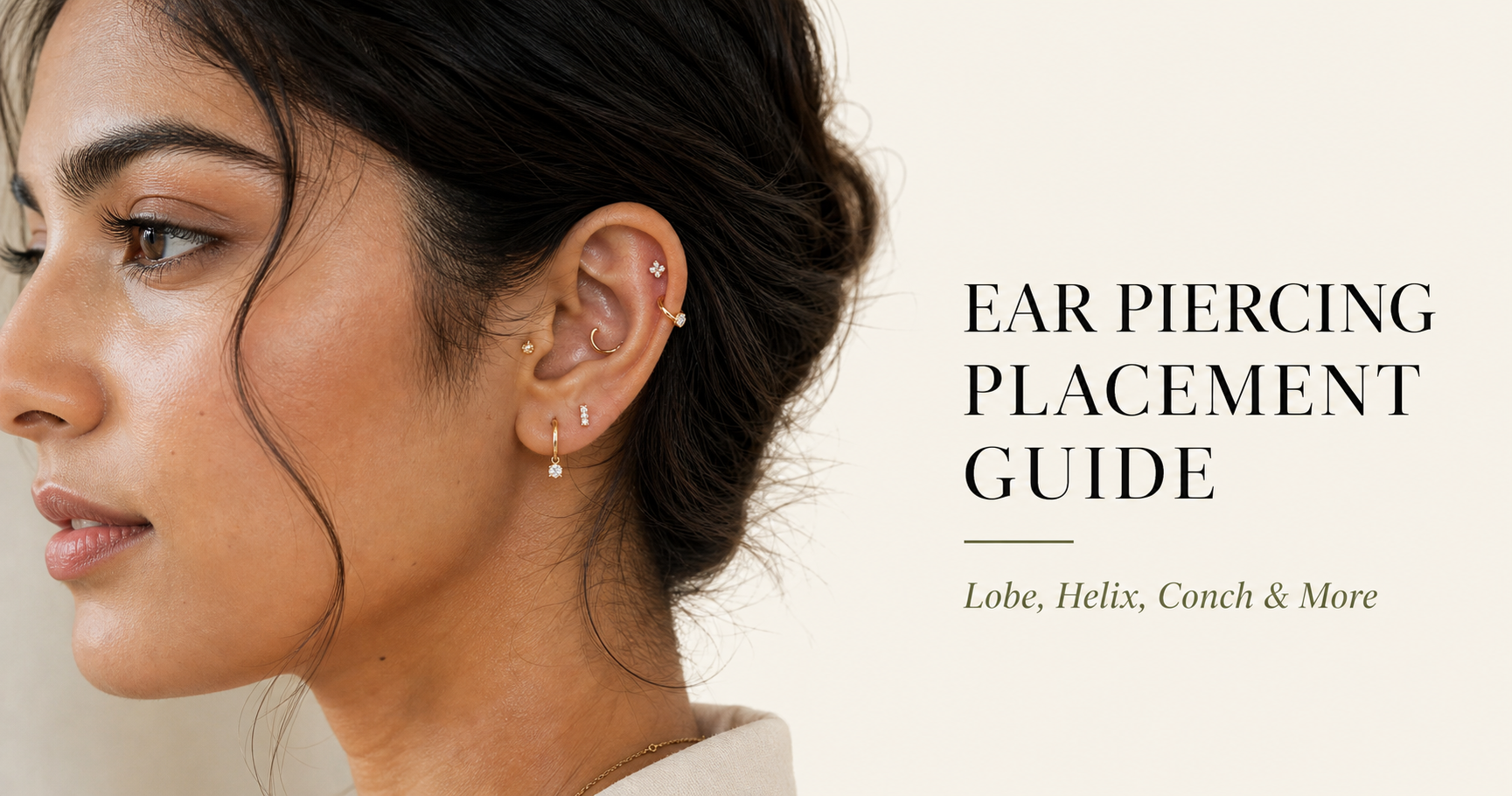
Choosing an ear piercing is partly about style and partly about anatomy. A placement that looks simple on one ear may need a different angle, diameter or backing on another. Use this guide to understand the most popular ear piercing locations, then let a qualified piercer confirm what works for your ear.
AURIVNA sensitive-skin note: Our jewelry is hypoallergenic and designed for sensitive skin. We label 925 sterling silver and titanium styles by their actual material so shoppers can choose confidently. Individual sensitivities can still vary, and a professional piercer should confirm jewelry for a fresh or actively healing piercing.
Ear Piercing Placement at a Glance
| Placement | Location | Common jewelry |
|---|---|---|
| Lobe | Soft lower ear | Stud, flatback or hoop |
| Helix | Outer upper cartilage | Flatback stud or healed hoop |
| Flat helix | Flat upper cartilage | Decorative flatback stud |
| Conch | Central bowl | Stud or healed hoop |
| Daith | Inner cartilage fold | Ring or clicker |
| Rook | Upper inner ridge | Curved barbell |
| Tragus | Flap at ear canal | Low-profile flatback |
Lobe and Stacked Lobe
The lobe is the softest and most versatile area for building an ear stack. First, second and third lobe piercings can follow the ear’s curve or form a vertical cluster. Explore stacked lobe jewelry.
Helix
The helix sits along the outer upper rim. A flatback stud creates a clean everyday look, while a hoop can frame the edge after the piercing is fully healed and your piercer confirms the change. See our helix collection and helix earrings guide.
Flat Helix
The flat helix uses the cartilage plane inside the upper rim. It is ideal for decorative studs because the front can sit visibly against the ear. Available space varies, so a piercer must confirm the angle. Browse flat helix jewelry.
Conch
The conch occupies the central bowl and can become the focal point of an ear stack. Compare a stud and hoop in our conch guide or shop the conch collection.
Daith
The daith passes through an inner cartilage fold. Not every ear has suitable anatomy, and ring diameter must allow room for swelling and cleaning. It is decorative; there is no reliable evidence that it treats migraine. Read our daith guide.
Rook and Anti-Tragus
The rook sits in the upper inner ridge, while the anti-tragus is lower and opposite the tragus. Both are anatomy-dependent. Review the rook size guide and browse rook and anti-tragus jewelry.
Tragus
The tragus is the small flap near the ear canal. Because earbuds may touch it, a low-profile backing is often preferred after swelling allows professional downsizing. See tragus jewelry.
How to Choose Your Next Placement
- Start with anatomy: assess folds, thickness and available space.
- Consider habits: headphones, helmets, glasses and sleep position affect comfort.
- Plan the whole ear: leave room for future placements.
- Choose verified materials: especially for new or healing piercings.
Before Your Appointment
Save inspiration photos, but expect the final marking to be adapted. Ask which gauge, wearable length, thread style and material standard will be used. The Association of Professional Piercers FAQ is a useful education source.
FAQs
Which placement heals fastest?
Healing varies by person and aftercare. Lobes often settle sooner than cartilage, but only a professional can evaluate individual healing.
Can one piece fit every placement?
No. Gauge, length, curve and diameter are placement-specific. Confirm measurements before ordering.
View all piercing jewelry by placement.