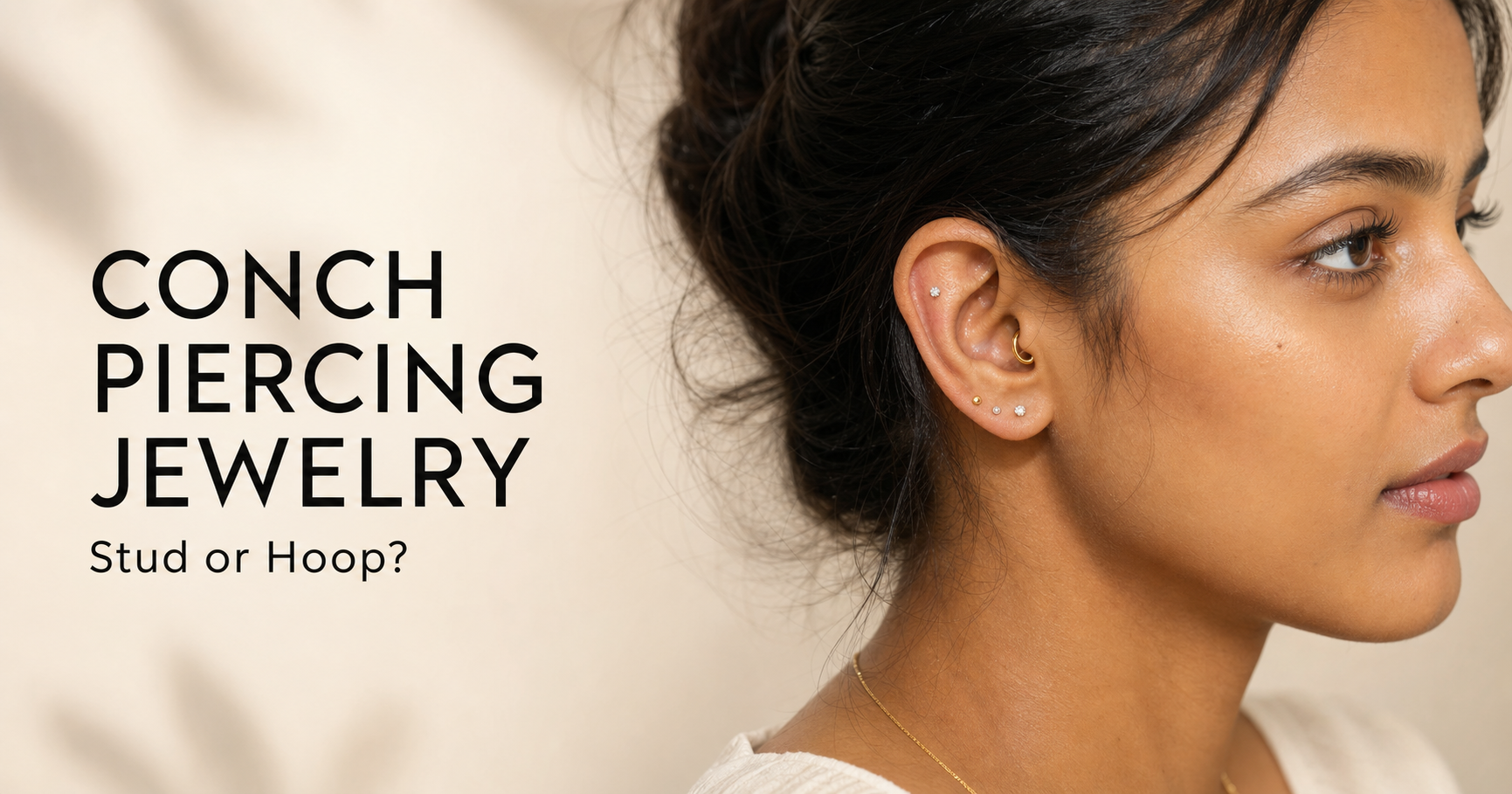
Conch jewelry sits near the center of the ear, so even a small change can reshape an entire ear stack. A low-profile stud creates a clean focal point, while a hoop traces the outer edge of the ear for a stronger silhouette. Neither option is universally better—the right choice depends on whether the piercing is healed, your anatomy, your daily routine, and the look you want.
AURIVNA sensitive-skin note: Our jewelry is hypoallergenic and designed for sensitive skin. We label 925 sterling silver and titanium styles by their actual material so shoppers can choose confidently. Individual sensitivities can still vary, and a professional piercer should confirm jewelry for a fresh or actively healing piercing.
This guide compares conch studs and hoops without treating one size or style as suitable for everyone. For individual fitting, always ask a qualified piercer to assess your ear in person.
What is a conch piercing?
A conch piercing passes through the cartilage in the bowl-shaped center of the ear. An inner conch sits deeper in the bowl and is commonly styled with a flatback stud. An outer conch sits closer to the ear's outer rim and may accommodate a hoop after healing, depending on placement and anatomy.
Browse Aurivna's conch piercing jewelry collection to compare low-profile studs and ring-inspired styles.
Conch stud vs hoop: the quick comparison
| Feature | Flatback stud | Hoop or clicker |
|---|---|---|
| Visual effect | Focused detail inside the ear | Bold line around the ear |
| Movement | Usually lower when properly fitted | More movement and contact |
| Everyday pressure | Can work well with a smooth flat back | May contact hair, phones or headphones |
| Fit measurement | Post length and end size | Gauge and internal diameter |
| Best timing | Commonly used during healing when selected by a piercer | Usually considered after full healing |
When a conch stud makes sense
A flatback stud keeps the decorative end inside the ear while a smooth disc rests behind it. When the post length is professionally fitted, the design can reduce unnecessary movement and avoid the projecting butterfly back used on conventional earrings.
A stud may be the practical choice if you regularly use a phone, wear over-ear headphones, have long hair, or prefer a quiet addition to an existing ear stack. Small bezel stones, stars, crescents and clusters can all work visually, but the end should not press into the surrounding cartilage.
Learn more about backing shapes in our guide to flatback and butterfly-back earrings.
When a conch hoop works best
A conch hoop wraps from the piercing channel around the outer edge of the ear. The effect is distinctive, but the ring must have enough internal diameter to clear the ear without squeezing it. A diameter that is too small can create pressure; one that is unnecessarily large may move, catch and rotate more than expected.
Most people should wait until the conch is fully healed before changing to a hoop. The Association of Professional Piercers explains that jewelry size, style, material and finish all affect healing, and that jewelry must be appropriate for the wearer's anatomy and placement. See its initial jewelry guidance.
How to choose the right size
Conch jewelry is not one-size-fits-all. A stud is described by gauge, post length and decorative-end size. A ring is described by gauge and internal diameter. Two ears with the same piercing placement may still require different dimensions.
- Gauge is the thickness of the wearable portion. Do not force a different gauge through an existing channel.
- Post length should leave appropriate room without excessive movement. Initial jewelry may be longer to allow swelling and later require professional downsizing.
- Internal diameter determines how closely a hoop fits around the ear.
- End size affects both the visual scale and whether the jewelry presses on nearby folds.
The APP notes that once initial swelling has subsided, returning to a piercer for a shorter post can reduce snagging and excessive movement. Read its piercing FAQ for further context.
Material matters
For a fresh or still-healing conch, use only material and construction approved by your piercer. Documented implant-grade titanium is lightweight and is widely used for initial piercings when it meets the relevant ASTM or ISO specification.
925 sterling silver can be attractive for healed piercings, but it is an alloy and may tarnish or contain metals that do not suit every wearer. It should not automatically be described as appropriate for a fresh piercing or guaranteed hypoallergenic. Read our piercing materials guide before choosing.
Think about your daily routine
Before choosing a design, consider what touches your ear during an ordinary week. Earbuds may sit near the conch bowl. Over-ear headphones can press on larger ends or rings. Hair, scarves and towels can catch decorative details. Sleeping directly on the ear can create sustained pressure even when the jewelry feels comfortable during the day.
A good fit should support your anatomy rather than requiring your ear to adapt to the jewelry. If the area becomes sore, swollen or indented, stop experimenting and ask a piercer to inspect the fit.
How to style conch jewelry
Minimal ear stack
Pair one small conch stud with two graduated lobe studs. Keeping the shapes simple lets the central placement stand out.
Balanced sparkle
Use a small cluster in the conch and a single fine hoop in the lobe. Leave visual space around the conch rather than filling every placement.
Statement hoop
Let a healed conch hoop become the largest line in the composition, then use tiny studs in the helix and lobe. Explore complementary helix piercing jewelry without repeating the same scale everywhere.
Frequently asked questions
Can a conch be pierced with a hoop?
Jewelry choice for a new piercing should be made by the piercer after assessing placement, swelling room and anatomy. Do not choose initial jewelry only for appearance.
When can I change my conch stud to a hoop?
Wait until the channel is fully healed and a piercer confirms that the placement can support the ring you want. A calm exterior does not always mean the cartilage channel has fully matured.
Why does my conch hoop feel tight?
The internal diameter may be too small, the angle may not suit a ring, or the tissue may be irritated. Do not force the hoop to sit flush. Have the fit checked professionally.
Is a flatback comfortable for sleeping?
A properly fitted flat disc may feel less bulky than a conventional backing, but no jewelry makes it safe to place sustained pressure on a healing piercing. Avoid sleeping directly on the area.
Choose fit before trend
Choose a conch stud when you want a low-profile focal point and controlled movement. Consider a hoop only after healing when your placement and anatomy allow the correct diameter. The best-looking result is jewelry that fits comfortably, leaves the surrounding tissue relaxed, and works with your real routine.
This article provides general education and is not medical advice. Healing and fitting needs vary. Consult a qualified piercer, and seek medical care for signs of infection or worsening symptoms.