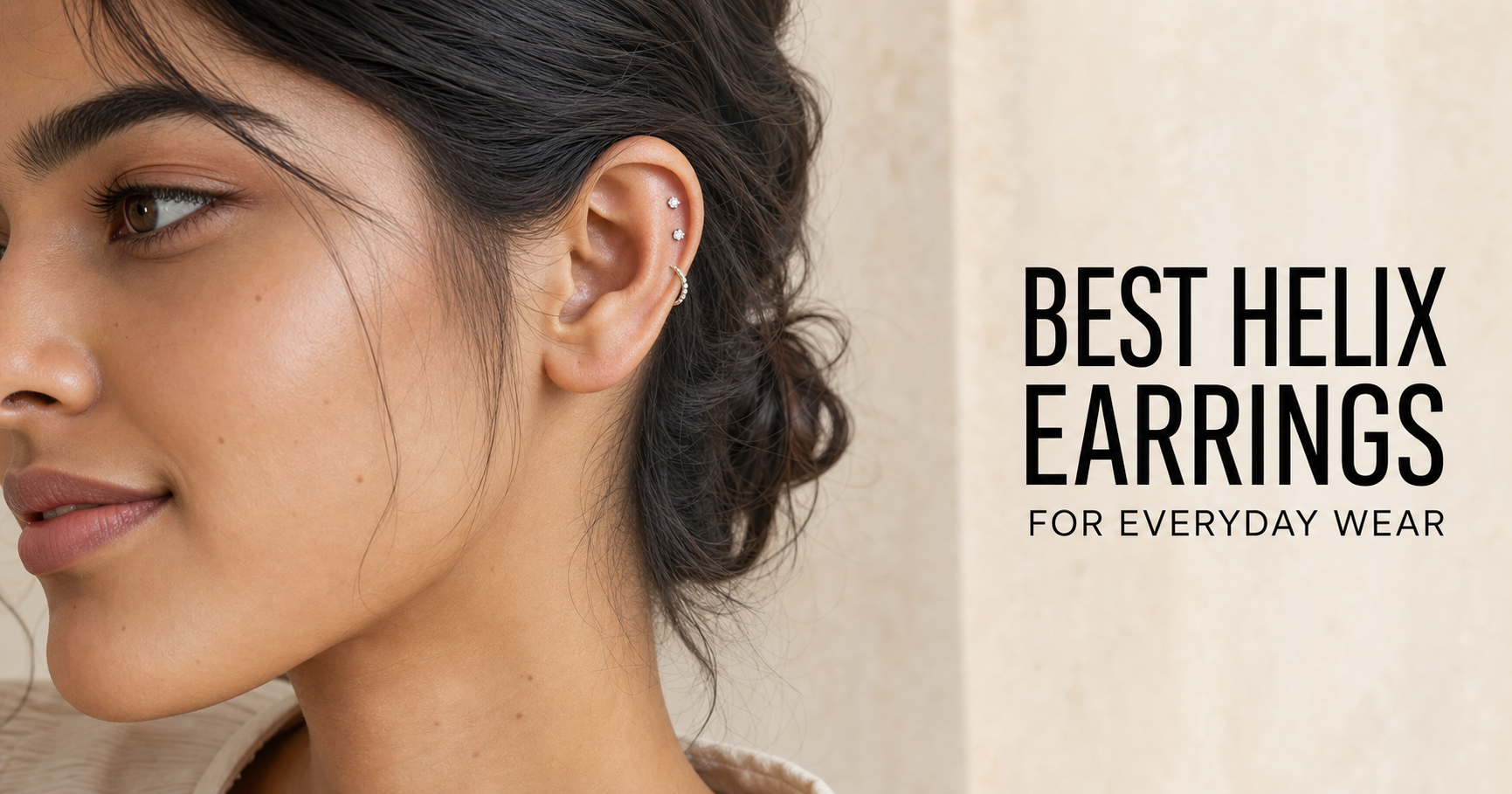
The best helix earring is not simply the smallest or most decorative option. For everyday wear, fit, surface finish, backing style and your daily routine matter just as much as appearance. A piece that looks delicate can still become uncomfortable if the post is too long, the ring is too tight, or the decorative end catches hair and clothing.
AURIVNA sensitive-skin note: Our jewelry is hypoallergenic and designed for sensitive skin. We label 925 sterling silver and titanium styles by their actual material so shoppers can choose confidently. Individual sensitivities can still vary, and a professional piercer should confirm jewelry for a fresh or actively healing piercing.
This guide explains how to compare helix studs and hoops for a healed piercing, what to discuss with a piercer during healing, and how to build an ear stack that remains practical from morning to night.
What makes a helix earring suitable for everyday wear?
A practical helix earring should sit securely without compressing the tissue, have a smooth wearable surface, and match the gauge and angle of the existing piercing. It should also work with the things that regularly touch your ear, including glasses, headphones, hair, helmets, scarves and pillows.
Start with Aurivna's helix piercing jewelry collection, then compare each design by backing, profile and size rather than choosing only by the front view.
Flatback studs: a low-profile option
A flatback stud uses a smooth disc behind the ear instead of a projecting butterfly backing. In a properly fitted, healed helix, the lower profile may reduce catching and leave more room for nearby jewelry. Flatbacks are also available with small decorative ends, including bezel stones, stars, crescents and clusters.
The post must still be the correct length. A post that is too tight can press on tissue, while an unnecessarily long post can tilt, move and catch. During healing, downsizing should be performed by a qualified piercer once swelling has settled. The Association of Professional Piercers explains why professional downsizing and appropriate fit matter.
For a direct comparison of backing shapes, read Flat Back vs Butterfly Back Earrings.
Helix hoops: clean lines with more movement
A small hoop or clicker can create a clean outline around the upper ear, especially when paired with simple lobe studs. However, a hoop normally moves more than a fitted stud and may interact with hair, glasses or headphones. Internal diameter is critical: a ring that is too small can pull or compress the piercing, while one that is too large can rotate and snag.
A hoop is usually better considered after the piercing is fully healed and a piercer confirms that the angle and placement can support it. Do not force a ring through a channel that feels resistant or painful.
Choose the correct gauge and length
Helix jewelry is described using several measurements:
- Gauge: the thickness of the part that passes through the piercing.
- Post length: the wearable length of a stud between the front end and back disc.
- Internal diameter: the open space inside a hoop.
- End size: the width or height of the decorative front.
Do not estimate these measurements from an online photograph. Use the size of professionally fitted existing jewelry as a reference, or ask a piercer to measure the healed channel and surrounding anatomy.
Material choices for daily contact
Material labels need to be specific. Documented implant-grade titanium must meet a recognized ASTM or ISO specification; the word “titanium” alone does not describe grade or finish. The APP's initial jewelry standards explain how material, threading, polish and dimensions affect a new piercing.
925 sterling silver may suit some people in healed piercings, but it is an alloy and may tarnish. It should not be presented as universally hypoallergenic or automatically appropriate for a fresh helix. If you have reacted to earrings before, review our materials guide for sensitive skin and ask a professional about verified composition.
Everyday comfort checklist
- The jewelry does not leave an indentation or pinch the ear.
- The front end does not overlap the ear rim or press into a fold.
- The post does not project far enough to catch hair repeatedly.
- A hoop clears the ear without pulling the channel downward.
- The closure feels secure and the wearable surface is smooth.
- Headphones, eyewear and helmets do not press on the jewelry.
Even comfortable jewelry does not make it advisable to sleep directly on a healing helix. Pressure can irritate the channel and may affect the piercing angle. See our cartilage piercing healing timeline for a realistic overview.
Five easy helix styling ideas
1. Single-point sparkle
Use one tiny bezel or polished bead in the helix and let the lobe carry the larger design. This creates a clear focal hierarchy.
2. Graduated ear stack
Arrange jewelry from larger at the lobe to smaller toward the helix. A small flatback at the top prevents the composition from feeling crowded.
3. Mixed shapes, consistent finish
Combine a star, round stone and slim hoop while keeping the metal finish consistent. Repeating one finish connects different motifs.
4. Helix and conch balance
Pair a quiet helix stud with a slightly larger conch jewelry design. Avoid making both placements compete at the same scale.
5. Stacked-lobe transition
Use progressively smaller pieces from a stacked lobe toward the helix to create a continuous curve.
When should you change helix jewelry?
Do not use a calmer-looking exterior as proof that the cartilage channel has healed. Wait until there is no persistent tenderness, swelling, discharge or crusting, and ask a piercer if you are uncertain. A professional downsize during healing is different from changing jewelry for style.
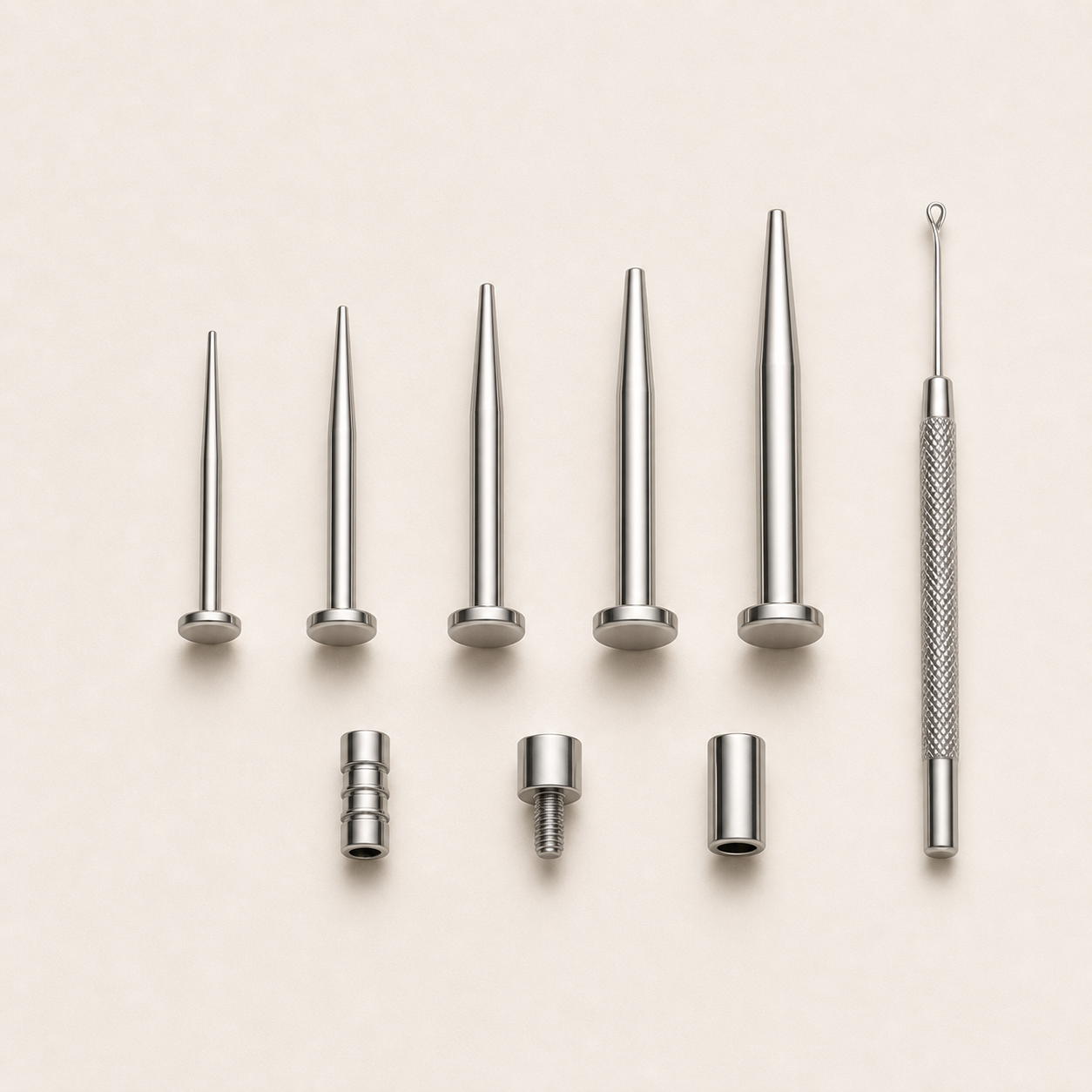
For a healed piercing, clean hands and compatible insertion tools may make handling small ends easier, but never force jewelry through resistance. Stop if there is sharp pain or bleeding.
Frequently asked questions
Are flatback earrings better for helix piercings?
They can provide a low-profile backing when correctly fitted, but the best style still depends on anatomy, placement, healing stage and dimensions.
Can I wear a helix hoop every day?
Many people wear a hoop in a fully healed helix. The ring must have the correct gauge and internal diameter and should not create pressure or repeated movement.
What size helix earring should I buy?
Use your professionally fitted jewelry measurements or have the piercing measured. There is no single post length or hoop diameter that fits every ear.
Why is my helix sore after changing jewelry?
The channel may not be fully healed, the new piece may be the wrong size, or the change may have irritated the tissue. Return to a qualified piercer if soreness persists or worsens.
Build a helix stack around fit
For everyday wear, begin with correct dimensions and a smooth, secure construction. Choose a flatback stud for a compact focal point or a properly fitted hoop for a clean outer line after healing. Once comfort is solved, styling becomes much easier.
This article is general educational information, not medical advice. Piercing anatomy and healing vary. Consult a qualified piercer for fitting and a healthcare professional for suspected infection or worsening symptoms.